
Both MRTA (Mortgage Reducing Term Assurance) and MLTA (Mortgage Level Term Assurance) are mortgage life insurance products that pay off your home loan if you pass away or become permanently disabled during the loan tenure. They protect your family from inheriting the debt. The difference lies in how the coverage works, and which suits which buyer.
Both are optional in Malaysia, but most banks strongly encourage one or the other when approving a loan. The right choice depends on your stage of life, total household coverage outside the mortgage, and whether you plan to stay in this property long-term. Our recommendation: discuss both with your banker, and run the numbers across the full loan tenure before deciding.
The Letter of Offer is the document the bank issues once your home loan is approved. It sets out every term of your loan, the amount, the rate, the tenure, the type of facility, the lock-in period, the early settlement penalty, and any additional conditions. Once you sign it, the loan is locked in. Reading the LO carefully before signing is one of the most important steps a buyer takes.
Below is a representative sample of what a Letter of Offer typically contains. The exact format varies by bank, but the key fields are consistent.
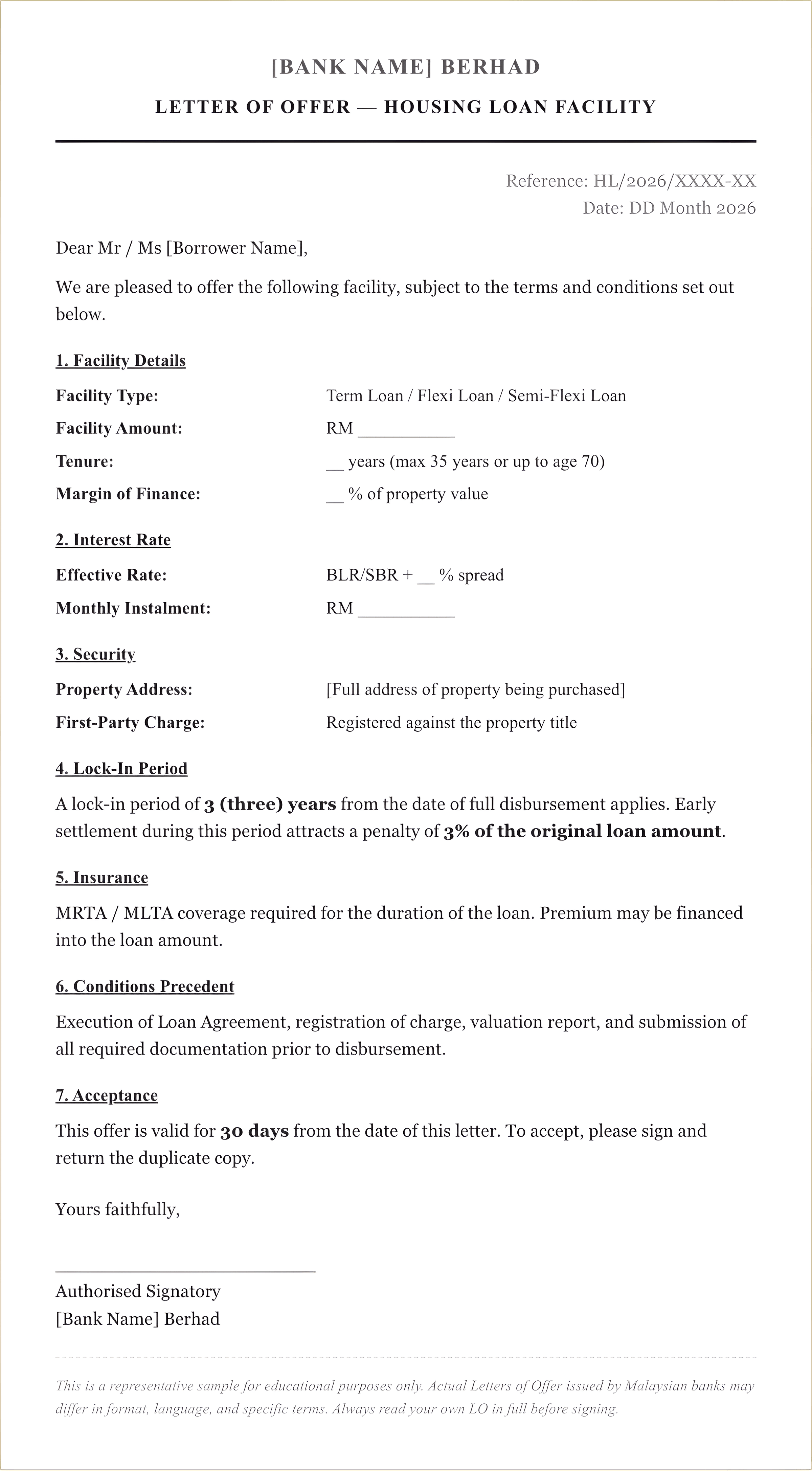
Things to look at carefully before signing: the lock-in period (commonly 3 to 5 years), the early settlement penalty, whether the rate is fixed or floating against BLR/SBR, and whether the loan is fully-flexi (allowing offset of savings against principal) or basic. Small differences here translate into thousands of ringgit over the loan tenure.
The Booking Form is the first formal step taken after a price is agreed between buyer and seller. By signing it and paying the 1 percent earnest deposit, the buyer locks the unit at the agreed price and effectively takes the property off the market. From the seller's side, signing acknowledges the offer and starts the timeline towards Sale and Purchase Agreement signing, typically 14 days later.
The Booking Form is short, usually one page, but every line on it matters. Below is a representative sample of what a typical Booking Form contains. Specific wording varies between agencies and law firms, but the core fields are consistent.
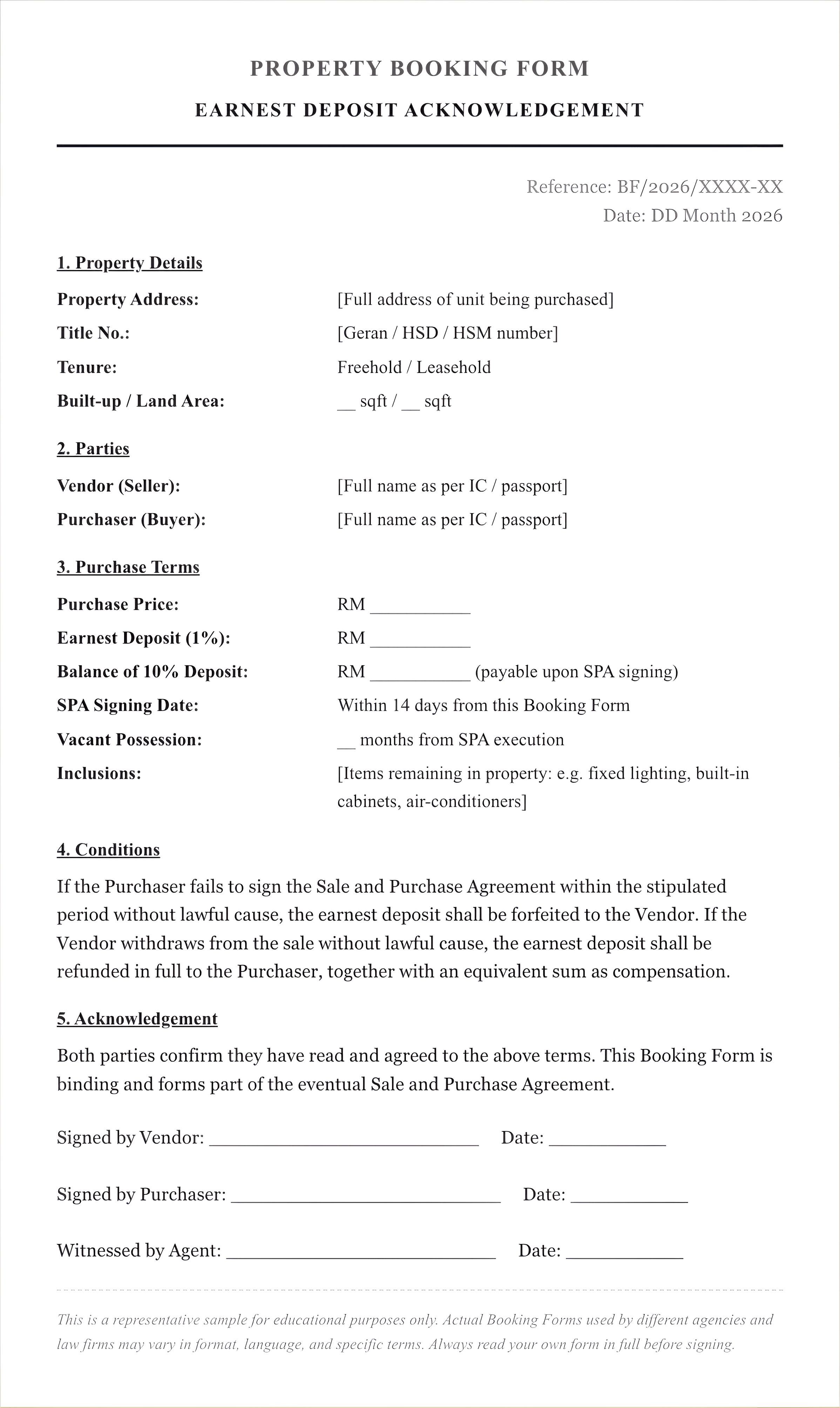
Two things to be especially careful about: the inclusions list (what stays in the house), and the vacant possession date. These two clauses are often glossed over in the rush to sign, but disputes after key handover, the missing aircon, the unexpected delay in moving in, almost always trace back to vague wording here. A clear inclusions list and a firm vacant possession date prevent most of the friction that can arise weeks or months later.
Malaysia My Second Home (MM2H) is the country's long-stay residency programme for foreign nationals. It is administered by the Ministry of Tourism, Arts and Culture (MOTAC), with property purchase often forming a central part of the application. The 2024 revised framework introduced three tiers — Silver, Gold, and Platinum — each with different requirements for fixed deposit, age, income proof, and visa duration.
In practice, the property tier and the visa tier are deeply connected. For Penang island specifically, the foreigner threshold of RM 3 million for landed property already exceeds the Silver and Gold property minimums, so most MM2H applicants buying landed in Penang island are aligning with the Gold or Platinum tier from the outset. Documentation, medical screening, fixed deposit lodgement, and ongoing compliance all require careful handling, and the rules have been revised more than once in recent years. Working with an MM2H-experienced lawyer alongside the property agent keeps both processes moving in step.
Real Property Gains Tax (RPGT) is the tax payable on the profit you make when selling a property. It applies to the chargeable gain, which is your selling price minus original purchase price, minus allowable costs (renovation receipts, legal fees, agent commission). RPGT is paid by the seller, not the buyer.
Three exemptions worth knowing for citizens and PRs: (1) automatic exemption of RM10,000 or 10 percent of the gain, whichever is greater, available to every individual; (2) once-in-a-lifetime exemption on the disposal of a private residence, which can wipe out the RPGT bill in full but can only be used once; (3) full exemption on family transfers between spouses, parents and children, or grandparents and grandchildren, when the transferor is a Malaysian citizen.
Foreigners do not have access to the once-in-a-lifetime exemption or the family-transfer exemption, and the rate never reaches zero. This is why RPGT planning matters more for foreign buyers, the longer-term hold is the only practical way to reduce the rate, and even then, 10 percent applies indefinitely from year six.
Freehold (Pegangan Bebas): ownership in perpetuity, with no expiry. The owner holds the title indefinitely and can transfer, sell, or pass it on without time restriction. The vast majority of landed property on Penang island is freehold.
Leasehold (Pajakan): ownership for a fixed period, typically 99 years from when the lease was first granted by the state. When the lease expires, the land reverts to the state, though renewal can usually be applied for (with a premium). Banks often lend less and shorter on leasehold properties with under 60 years remaining, so always check the unexpired lease term before buying.
Malay Reserved Land (Tanah Rizab Melayu): land reserved for Malay ownership, with transfer restrictions enforced under the Malay Reservation Enactment. Non-Malays cannot purchase Malay Reserved Land. This applies regardless of buyer nationality, citizen or foreigner. A title search will identify Malay Reserve status before any commitment is made.
Restriction in Interest (Sekatan Kepentingan): a small number of titles carry conditions that limit how the property can be transferred, for example, requiring state consent before any sale. These are noted on the title and identified during the lawyer's title search.
Common terms that come up in landed property transactions in Malaysia.
The principal legal contract between buyer and seller. It sets out the price, terms, completion timeline, and obligations of both sides. Once signed, both parties are legally bound.
The legal instrument that transfers ownership of the title from seller to buyer at the land office. Stamp duty is calculated and paid on the MOT.
The first formal step after price is agreed. Buyer pays 1 percent earnest deposit and signs the Booking Form, locking the unit and starting the timeline towards SPA signing (typically 14 days later).
The point at which the seller hands over the empty property to the buyer, including keys and access. Marks the practical completion of the sale.
A registered claim or restriction on the property title, often by a bank (loan), a third party (dispute), or a buyer (private caveat). Must be cleared before clean transfer can take place.
When a property has an existing loan, redemption is the process of paying off that loan in full to release the title. Coordinated by the seller's lawyer between the seller's bank and the buyer's bank.
The release of approved loan funds by the bank to the seller's lawyer's account, triggering the final stages of completion. Usually the last major financial step before key handover.
For foreign buyers in Penang, formal approval from the state government is required before title transfer can register. Adds 2 to 4 months to the timeline and involves payment of the state levy.
Base Lending Rate (BLR) and Standardised Base Rate (SBR) are reference rates set by Bank Negara Malaysia. Most home loans are quoted as BLR or SBR plus a spread (e.g. SBR + 0.45%).
Quit rent (cukai tanah) is paid annually to the state government for landownership. Assessment (cukai pintu / cukai taksiran) is a property tax paid to the local council. Both transfer to the new owner upon sale.
